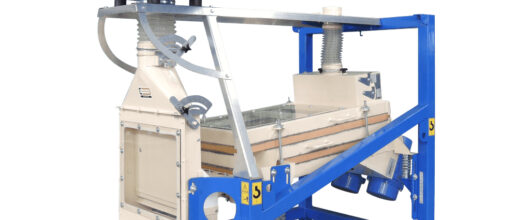
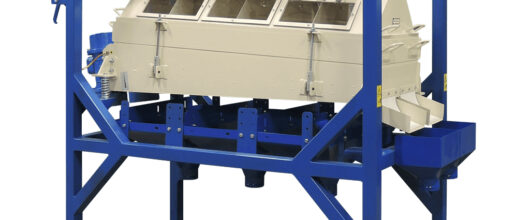
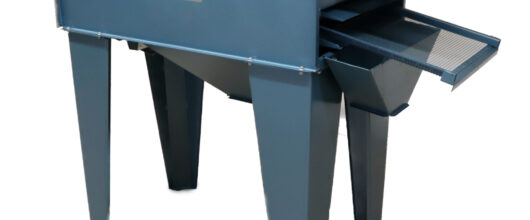
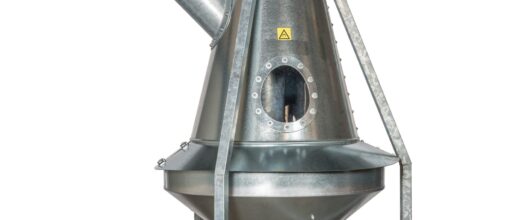
Description Gravity Table
The gravity table is designed for sorting materials with different specific weights but the same kernel size. These machines are used for cleaning planting seeds and fine seeds, as well as in the plastics, minerals, chemical and recycling industries.
In combination with a sieve cleaner, the gravity table achieves a cleaning purity of more than 99.9%.
How the Gravity Table works
The product passes over a slightly inclined, vibrating perforated deck. The heavier material maintains contact with the perforated deck and, due to the vibrating motion, is conveyed along with it. Lighter material rests on top of the layer, has no contact with the vibrating motion, and floats across the air deck towards the opposite side. This operating principle is illustrated in the animation. The vibrating motion here runs from left to right.
At the end of the table, the material falls into a hopper. Adjustable dividers split the flow into multiple fractions. The inclination angle, vibration speed and air volume are all easy to adjust.
In the animation, the heavy particles are shown in black, the light particles in purple and the middle fraction in yellow. In practice, five fractions are typically produced. The heaviest and lightest fractions, as well as the second heaviest and second lightest, are clearly separated. The middle fraction is returned and separated again.
Applications of the Gravity Table
- Grains – wheat, barley, rye, oats, maize: separating full, heavy kernels from light or damaged kernels
- Pulses – peas, beans, soy: quality sorting
- Seeds – grass seed, rapeseed, beet seed, vegetable seeds: removing light or damaged seeds
- Rice – separating filled and empty kernels
- Coffee and cocoa – quality separation of beans
- Nuts – hazelnuts, walnuts, peanuts: removing empty or light nuts
- Plastic granulate – density sorting in recycling
- Minerals and sand – separation of materials with different densities
- Chemical products – granulate, pellets
Options
- Bagging installation for the sorted fractions
- Cover for connection to dust extraction
- Extraction fan for above the sorting table
Technical data
| 12 | 23 | ||
| Capacity (indication) | |||
| small seeds (poppy seed, cumin seed, grasses, clover) | kg/hour | 100 – 300 | 500 – 1.000 |
| Granen (wheat, oats) | kg/hour | 400 – 900 | 1.500 – 3.500 |
| Oliezaden (flax, mustard) | kg/hour | 200 – 500 | 800 – 1.600 |
| Dimensions (indication) | |||
| Length | mm | 1.440 | 2.625 |
| Width | mm | 1.125 | 1.620 |
| Height | mm | 1.545 | 1.685 |
| Others | |||
| Table area | m² | 0,6 | 2,3 |
| Power | kW | 0,3 | 0,37 |
| Power of fan | kW | 4 | 11 |
| Weight (indication) | kg | 540 | 910 |
Remarks
- Machine capacities are indicative and depend on the type, quality, moisture content and impurity level of the processed product.
- The required fan power depends on the type of product.
Advantages of the Gravity Table
Separation by specific weight Products that are equal in size and shape but differ in weight are still effectively separated. This provides a solution where sieving alone is insufficient.
High accuracy The separation is highly precise. Light, damaged or shrivelled particles are effectively removed.
Adjustable Inclination angle, vibration speed and air volume can each be adjusted independently, making the machine suitable for a wide range of products.
Multiple fractions simultaneously Adjustable dividers in the collection hopper separate multiple quality grades in a single step.
No additives required The process works purely mechanically and with air. No liquids or chemicals are involved.
Clean and dry process The product remains dry and undamaged, making it suitable for food products and seeds.
Versatile From grains and seeds to plastic granulate and minerals — the gravity table works across a wide range of products.
Contact
For more information or a customised offer, please contact Jansen&Heuning.
- Phone: +31(0)50 3126 448
- E-mail: sales@jh.nl
- Contact form: jh.nl/contact