Chain conveyors

{{ query }}
{{ filter.name }}
Filter products

Chain conveyors

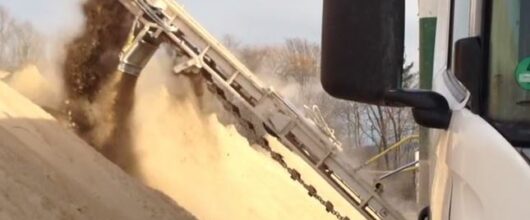
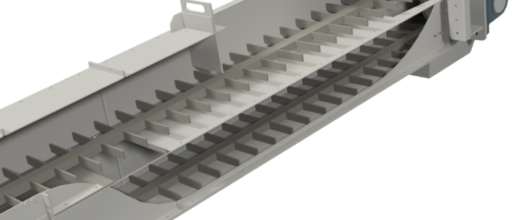
The chain conveyor transports powders and granules in a fully enclosed trough, in which a chain with flights runs.

In a horizontal and slightly inclined configuration, a layer thickness is conveyed that is much higher than the chain itself. The system is suitable for controlled and dust-tight transport over relatively short to medium distances.

Chain conveyors can be executed in S-shape and C-shape, enabling complex routes to be realised with a single conveyor.

Animation of a dosing chain conveyor

In the animation you can open and close the gates of the inlets and the intermediate outlet. Inlet A has a double bottom and a dosing gate. Use the slider buttons to control everything. Inlets A and B cannot be open at the same time.

Required power for chain conveyors

The required power depends on the capacity, the length and the friction of the product. For horizontal transport of granular products such as grain, flour and animal feed, the power can be estimated using:

Power (kW) = Capacity (t/h) x Length (m) x 0.003

As an example:
a chain conveyor of 20 metres long with a capacity of 50 tonnes per hour requires 3 kW.

For ores and crystalline products such as salt and sugar, the factor 0.003 is two to three times higher. For a precise calculation, use the calculation tool of Jansen & Heuning.

Application chain conveyors

If products are non-sticky, they are suitable for a chain conveyor.

  • Products that are readily possible:
    Granules: all types of grain, animal feed, cement, biomass, lime, sulphur, cocoa beans, coffee beans, sugar, salt, nuts, peanuts, almonds, sand, gravel, etc.
    Powders: flour, meal, semolina, starch, milk powder, cocoa powder, dried vegetables, bentonite, fly ash, stone meal, etc.
  • In industries such as agriculture, chemical, food, food ingredients, minerals, construction materials, biomass, recycling industry, wastewater treatment, etc.
  • Chain conveyors are suitable for much higher temperatures than conveyor belts. All components are made of steel and can be manufactured in heat-resistant steel if required.
  • Chain conveyors are most suitable for lengths from 8 to 80 metres. The limiting factor for the length is the tensile load in the chain.
  • Multiple volumetric dosing inlets and outlets with or without slide gates can be freely positioned, for example for unloading or filling a row of silos.
  • For transport in two directions, either a double bottom or two drives are applied
  • Applicable in straight, Z-, S-, or Cshaped routes

About Jansen&Heuning

Since 1901, Jansen & Heuning has been designing and building bulk handling installations from the Netherlands, for customers worldwide. With in-house engineering, in-house production and a direct approach, we deliver reliable standard solutions and professional custom work. We think along. Whatever it takes.

more about us

Types of chain conveyor

On the product pages, information is provided about the various types of chain conveyors.

Advantages of chain conveyors

  • Fully enclosed, therefore dust-tight and safe
  • Easily maintained under negative pressure with a small spot filter
  • Suitable for high temperatures
  • No contamination when changing products
  • More energy-efficient than screw conveyors, especially when plastic bottom plates are applied
  • Long service life provided that chain speed is not selected too high
  • Volumetric dosing inlets at all positions
  • Outlets with or without slide gate at all possible positions
  • Low and simple maintenance
  • Chain tension easily adjustable at the tensioning station
  • Due to the low speed, limited ATEX provisions are required, if applicable

Execution options and accessories chain conveyor

  • Chain conveyors are available in many configurations
  • All possible material types for trough and chain (steel, stainless steel, heat-resistant, wear-resistant, etc.)
  • Plastic bottom plates for low friction
  • Controlled capacity with adjustable layer thickness at the inlet
  • Outlets: open, with electro-pneumatic, electric or manual slide gate
  • Slide gates with spill collection
  • Scraper strips on the flights to clean the corners
  • Return buckets on the chain for complete cleaning of the trough
  • Double bottom for transport in two directions
  • Drives on both ends for transport in two directions
  • Overflow valve with sensor for full or blocked discharge
  • Speed monitor for detecting chain breakage or drive failure
  • Indoor or outdoor installation

Calculate your own conveyor system

Do you want to know which system is right for you? With the Jansen&Heuning calculation tool you can calculate yourself (for free!) which product suits best.

Is the chain conveyor not the ideal solution for your situation? Then take a look at our belt conveyors, screw conveyors and bucket elevators. Or contact us. We will look for a solution together.

Copyright - Jansen&Heuning