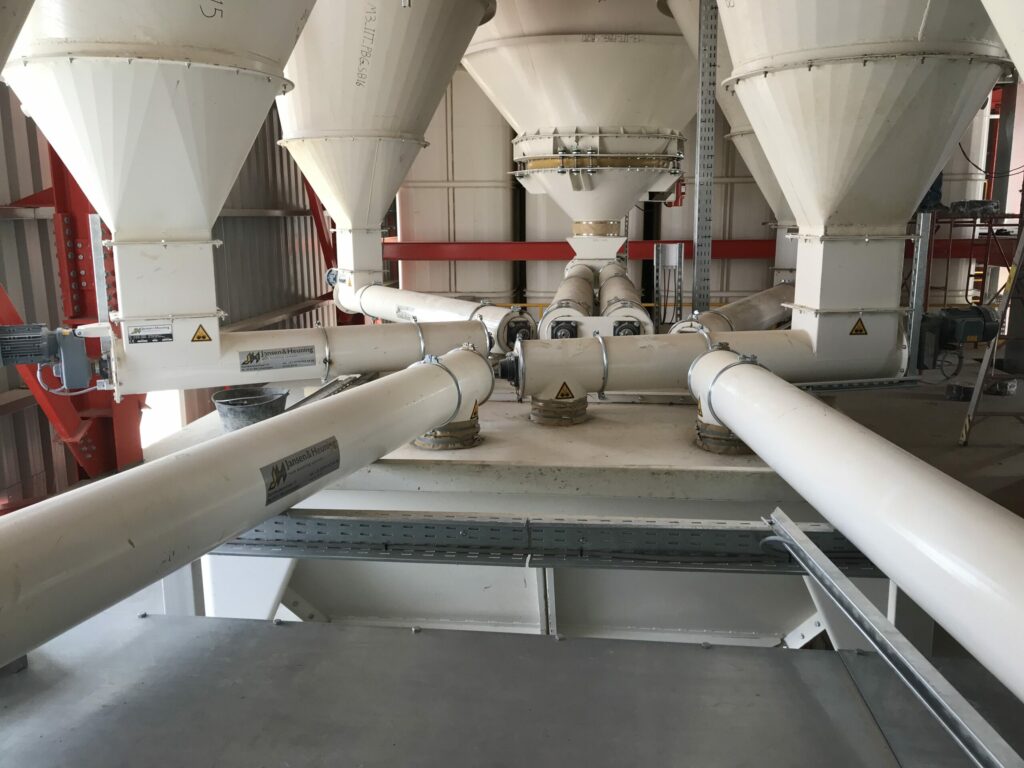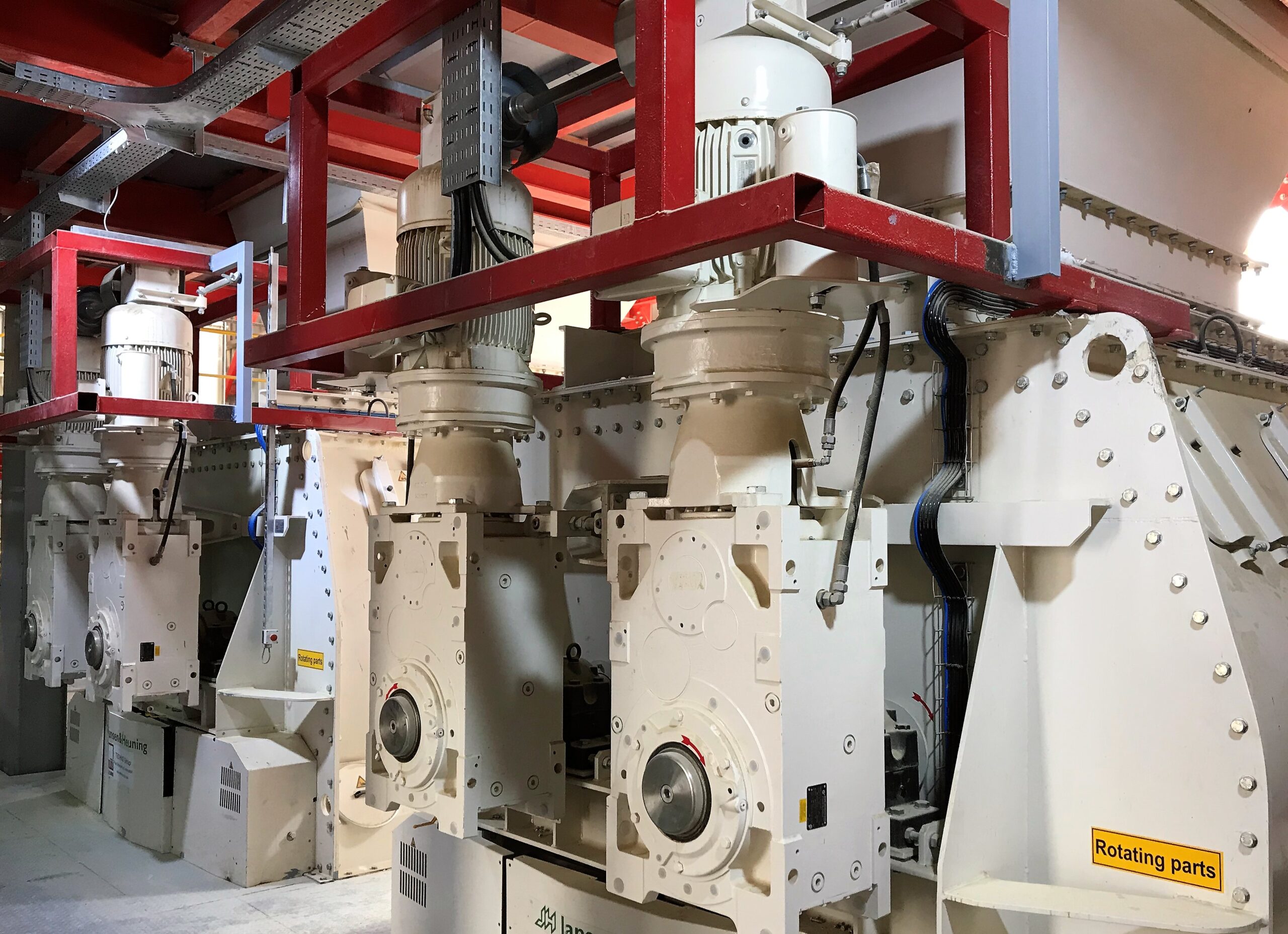
Description Paddle mixer
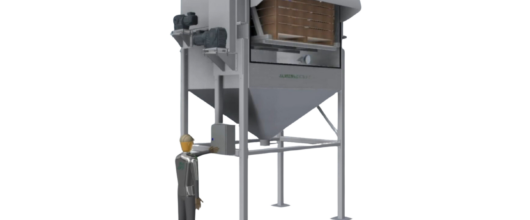
The paddle mixer has been developed for intensive and uniform mixing of dry bulk goods, powders and granulates. The machine combines high mixing quality with a robust construction for industrial applications.
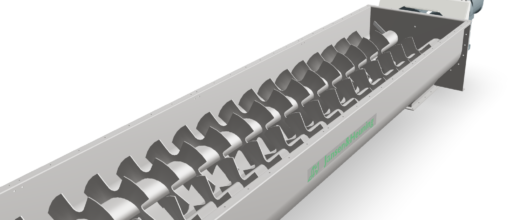
Two mixing shafts rotate through each other in opposite directions and are equipped with paddles. This creates a continuous product flow in which the material is actively mixed. This results in a uniform and consistent end product.
With a net capacity of 2,000, 4,000, 6,000 and 10,000 dm³ and a capacity up to 75 tonnes per hour, this mixer is suitable for demanding production environments worldwide.
Video paddle mixer in practice
Application Paddle mixer per type of product
Paddle mixers are technically positioned between:
- Ribbon mixers, which mix less intensively
- Ploughshare mixers, which mix more intensively and turbulently
The choice for a paddle mixer is logical when a balance is required between mixing intensity, product preservation and flexibility in product types.
This type of mixer is particularly suitable when:
- The product is relatively free flowing
- A homogeneous mixture is required with short mixing times
- Addition of liquids to dry materials is required
- The particle structure must be preserved as much as possible
Typical product categories
Paddle mixers are widely used for powders and granulates and other dry bulk goods such as:
- Food powders, for example flour, milk powder and spice mixes
- Chemical powders such as pigments, additives and detergents
- Minerals and building materials such as cement, lime and sand fractions
- Plastic granulates and compound mixtures
These products typically have a relatively uniform density and are not strongly cohesive.
Wet or semi-wet mixtures
Due to the intensive movement, paddle mixers are also suitable for:
- Moistening powders with water, oil or binders
- Mixing slurries or paste-like products
- Conditioning bulk goods for further processing, for example granulation
The mixer ensures uniform liquid distribution without agglomeration.
Fragile or structure-sensitive products
Paddle mixers have relatively low internal friction compared to high shear mixers. Therefore they are suitable for:
- Granulates that must not break
- Flakes and fibrous materials
- Mixtures where segregation must be prevented
Industrial applications Paddle mixer per industry
Food industry
In this sector paddle mixers are used for:
- Spice and seasoning mixtures
- Bakery mixes such as flour and additives
- Instant products such as soup and sauce powders
- Animal feed and pet food
Key requirements are hygienic design and cleanability, often according to EHEDG guidelines.
Chemical industry
Applications include:
- Mixing of pigments and colourants
- Production of detergents and cleaning powders
- Fertilisers and agrochemicals
- Additives for coatings and plastics
Process control is important here, including mixing time and reproducibility.
Construction and minerals
Common applications are:
- Dry mortars and cement mixtures
- Lime and gypsum products
- Fillers and mineral blends
In this sector robustness and wear resistance are important.
Pharmaceutical industry
Typical applications:
- Mixing of excipients and ative substances
- Preparation of tablet and capsule mixtures
Strict requirements apply regarding validation, traceability and cleanability.
Practical selection criteria
The following parameters are decisive:
- Bulk density and flow properties
- Content and type of liquid addition
- Required mixing homogeneity and batch time
- Sensitivity to breakage or segregation
- Cleaning and hygiene requirements
Specifications Paddle mixer
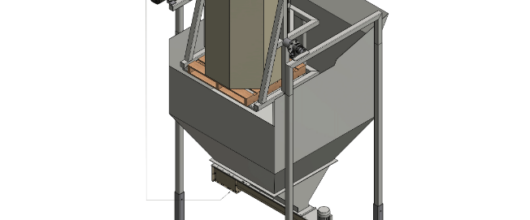
- Drive with two coupled geared motors, required due to intermeshing mixing shafts
- Large pneumatically operated inlet and discharge opening
- Buffer hopper above and below the mixer for fast filling and discharge
Technical specifications
| Technical specifications | JHMP02 | JHMP04 | JHMP06 | JHMP08 |
| Mixing capacity (tonnes/hour) | 15 | 30 | 45 | 75 |
| Batch size (dm³) | 2000 | 4000 | 6000 | 10000 |
| Batch size (kg) | 1000 | 2000 | 3000 | 5000 |
| Batch time (minutes) | 1-3 | 1-3 | 1-3 | 1-3 |
| Mixing time dry product (minutes) | <1 | <1 | <1 | <1 |
| Mixing time with liquid | <2 | <2 | <2 | <2 |
| Mixing accuracy | 1:10000 | 1:10000 | 1:10000 | 1:10000 |
| Drive (kW) | 1 x 22 | 1 x 37 | 1 x 45 | 2 x 45 |
| Installation height mixer (mm) | 2050 | 2350 | 2600 | 2900 |
| Width mixer (mm) | 2050 | 2300 | 2600 | 3500 |
| Length mixer (mm) | 2800 | 3400 | 4100 | 4700 |
Advantages of the paddle mixer
- Good mixing
- No product degradation
- Short mixing time
- Heavy duty industrial construction
- Fast filling and discharge
- Complete discharge due to full opening bottom with valves
Execution options and accessories
- Buffer silo above and below the mixer for continuous product flow
- Weighing system on the upper buffer for correct recipe composition
- Addition of one or more liquids
Contact
For more information or a tailored quotation, please contact Jansen&Heuning:
- Phone: +31(0)50 3126 448
- Email: sales@jh.nl
- Contact form: jh.nl/en/contact/